COSMO-LYA researchers probe the Universe’s initial conditions with DESI Lyman-α forest measurements
Researchers in the COSMO-LYA project, including Jonás Chaves-Montero and Andreu Font-Ribera, have led the cosmological analysis of the one-dimensional Lyman-α forest power spectrum from the first data release of the Dark Energy Spectroscopic Instrument (DESI).
Their results are presented in “Cosmological analysis of the DESI DR1 Lyman-α 1D power spectrum” (https://arxiv.org/abs/2601.21432). This work shifts the focus of COSMO-LYA to the clustering of matter on nonlinear scales, providing new insight into the early Universe and into the properties of weakly interacting particles.
Probing the early Universe with the Lyman-α forest
The primary aim of COSMO-LYA is to deepen our understanding of dark energy, the initial conditions of the Universe, and possible extensions of the Standard Model through detailed analyses of the Lyman-α forest. While much of the project’s earlier work focused on constraining dark energy, this study instead addresses the latter two objectives. By combining DESI Lyman-α measurements with cosmic microwave background data from Planck and DESI baryon acoustic oscillation (BAO) results — where the COSMO-LYA collaboration played a leading role — the analysis substantially tightens constraints on the initial conditions of the Universe, the existence of additional light relics beyond the Standard Model, and the sum of neutrino masses.
Tighter constraints from combined cosmological datasets
This study marks a new milestone in the long-term COSMO-LYA programme, which combines cosmological simulations, machine-learning–based emulators for fast and accurate modelling of the Lyman-α signal, and a detailed treatment of the astrophysical effects to model the Lyman-α forest measurements down to nonlinear scales. The cosmological inference was carried out under blinded conditions, minimising human bias and ensuring robust, reliable results.
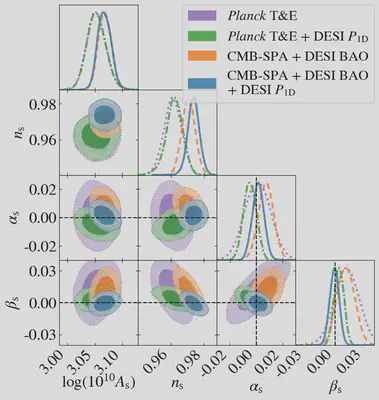
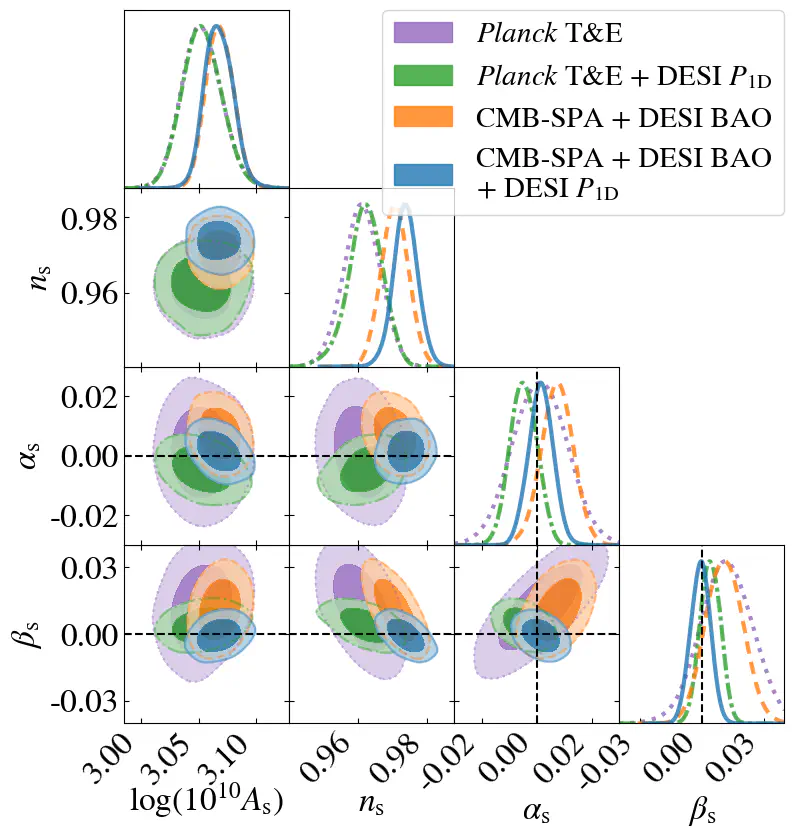
The comparison shown in the figure highlights the impact of the DESI Lyman-α measurements on cosmological constraints. When combined with cosmic microwave background and baryon acoustic oscillation data, the COSMO-LYA results lead to substantially tighter bounds on the parameters of the primordial power spectrum that govern the large-scale distribution of matter in the Universe. This improvement underscores the role of the Lyman-α forest as a powerful and complementary probe of the early Universe, capable of enhancing the constraining power of current cosmological datasets.
Together, these results provide an important step toward a more precise understanding of the primordial Universe and of low-interaction particles that leave subtle imprints on the growth of cosmic structure.