Publications

CoLoRe-2LPT: Lyman-$\alpha$ mock catalogues for the validation of DESI cosmological analyses
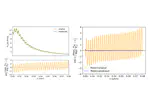
The Lyman-$\alpha$ (Ly$\alpha$) forest has become a crucial probe for studying the large-scale structure of the Universe at high redshift ($z > 2$), providing powerful constraints on Baryon Acoustic Oscillations (BAO) and the full-shape (FS) clustering of matter. As a key ingredient for upcoming BAO and FS analyses, we present a new generation of fast cosmological Ly$\alpha$ mocks based on second-order Lagrangian perturbation theory (2LPT). These new mocks significantly improve upon previous log-normal approaches, both at accurately capturing small-scale clustering and at recovering the non-linear broadening of the BAO peak. They reproduce Ly$\alpha$ statistics within $10%$ of the latest DESI measurement, including the Ly$\alpha$ bias and redshift-space distortion $\beta$ parameter, mean transmitted flux, and 1D power spectrum. The corresponding quasar clustering is also improved with respect to previous approaches, recovering the observational quasar linear bias to better than $5%$. The mocks also incorporate high column density systems and metal lines, allowing the study of systematic effects induced by astrophysical contaminants. This new set of mocks has been a key ingredient in the modeling and validation of the DESI DR2 Ly$\alpha$ full-shape cosmological analysis and provides a physically motivated and computationally efficient tool for current and next-generation Ly$\alpha$ surveys.
CoLoRe-2LPT: Lyman-$\alpha$ mock catalogues for the validation of DESI cosmological analyses
DESI DR2 Results IV: Alcock-Paczyński Measurements from the Lyman Alpha Forest and Cosmological Constraints
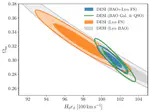
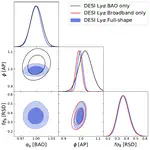
We present Alcock-Paczyński (AP) measurements from the full shape of Lyman-$\alpha$ (Ly$\alpha$) forest correlation functions measured from the second data release (DR2) of the Dark Energy Spectroscopic Instrument (DESI). Our measurements include information from the Ly$\alpha$ forest auto-correlation and its cross-correlation with quasars. We constrain the AP effect with $1%$ precision at an effective redshift $z_\mathrm{eff}=2.33$, which is twice as tight as the Baryon Acoustic Oscillation (BAO) constraint from the same data. When using the joint Ly$\alpha$ AP and BAO results, we measure the ratios $D_\text{H}(z_\mathrm{eff})/r_\text{d}=8.600 \pm 0.066$ and $D_\text{M}(z_\mathrm{eff})/r_\text{d}=39.32 \pm 0.33$. Assuming $\Lambda$CDM, Ly$\alpha$ forest measurements combined with a nucleosynthesis prior produce a constraint on the Hubble constant $H_0=66.5\pm1.3,\mathrm{km,s^{-1},Mpc^{-1}}$. The Ly$\alpha$ AP result corresponds to a matter fraction constraint $\Omega_\text{m}=0.325\pm0.018$ in $\Lambda$CDM, which is $1.4\sigma$ higher than DESI BAO. This impacts the DESI results relative to the Cosmic Microwave Background (CMB), slightly reducing their discrepancy from $2.4\sigma$ to $2.2\sigma$. We also present updated constraints on extended cosmological models using the joint DESI DR2 BAO and Ly$\alpha$ forest full-shape data together with external datasets.
DESI DR2 Results IV: Alcock-Paczyński Measurements from the Lyman Alpha Forest and Cosmological Constraints
Lyman-$\alpha$ forest holography: 3D predictions from 1D measurements
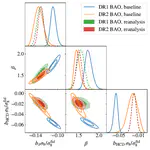
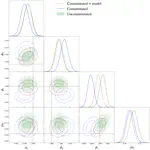
Cosmological analyses of Lyman-$\alpha$ forest clustering rely on either one-dimensional correlations along individual sightlines or three-dimensional correlations between different sightlines. Because these observables probe the matter distribution on very different scales, they have traditionally been analyzed independently. In this work, we bridge this gap using ForestFlow, an emulator trained on a suite of cosmological hydrodynamical simulations that provides a unified description of Lyman-$\alpha$ forest clustering from linear to nonlinear scales. This framework enables us to determine the range of three-dimensional clustering models compatible with the DESI one-dimensional flux power spectrum ($P_{\rm 1D}$). The resulting predictions successfully reproduce the large-scale clustering measured by the DESI BAO analysis and provide physically motivated priors on nonlinear clustering that are used in a companion paper presenting the full-shape analysis of the DESI DR2 Lyman-$\alpha$ forest. We validate our methodology using the large-volume, high-resolution hydrodynamical simulation ACCEL-2, demonstrating excellent agreement across the full range of scales considered. Finally, we combine constraints from the $P_{\rm 1D}$ and BAO analyses on the parameter combinations $b_\delta \sigma_8$ and $b_\eta f \sigma_8$, finding that the two probes provide comparable constraining power while exhibiting complementary parameter degeneracies. Our results establish a direct connection between one- and three-dimensional Lyman-$\alpha$ forest measurements through ForestFlow, an approach we term Lyman-$\alpha$ holography by analogy with the reconstruction of higher-dimensional structure from lower-dimensional information.
Lyman-$\alpha$ forest holography: 3D predictions from 1D measurements
Cosmological analysis of the DESI DR1 Lyman alpha 1D power spectrum
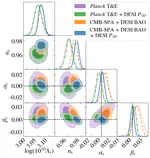
We present the cosmological analysis of the one-dimensional Lyman-$\alpha$ (Ly$\alpha$) flux power spectrum from the first data release of the Dark Energy Spectroscopic Instrument (DESI). We capture the dependence of the signal on cosmology and intergalactic-medium physics using an emulator trained on a cosmological suite of hydrodynamical simulations, and we correct its predictions for the impact of astrophysical contaminants and systematics, many of which were not considered in previous analyses. We employ this framework to constrain the amplitude and logarithmic slope of the linear matter power spectrum at $k_\star = 0.009,\mathrm{km^{-1},s}$ and redshift $z = 3$, obtaining $\Delta_\star^2 = 0.379 \pm 0.032$ and $n_\star = -2.309 \pm 0.019$. The robustness of these constraints is validated through the analysis of mock data and a large number of alternative data-analysis variations, with cosmological parameters kept blinded throughout the validation process. We then combine our results with constraints from DESI baryon acoustic oscillations and temperature, polarization, and lensing measurements from Planck, ACT, and SPT-3G to constrain extensions of $\Lambda$CDM. While our measurements do not significantly tighten the limits on the sum of neutrino masses from the combination of these probes, they sharpen the constraints on the effective number of relativistic species, $N_\mathrm{eff} = 3.02 \pm 0.10$, the running of the spectral index, $\alpha_s = 0.0014 \pm 0.0041$, and the running of the running, $\beta_s = -0.0006 \pm 0.0048$, by factors of 1.18, 1.27, and 1.90, respectively. We conclude by outlining the improvements needed to fully reach the level of confidence implied by these uncertainties.
Cosmological analysis of the DESI DR1 Lyman alpha 1D power spectrum
Calibrating redshift distributions at z>2 with Lyman-α forest cross-correlations
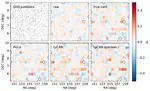
We explore the feasibility of using Lyman-$\alpha$ (Ly$\alpha$) forests to calibrate the ensemble redshift distribution of the high-redshift tail ($2 < z < 3$) of photometric galaxies. We use \texttt{CoLoRe} simulations to create mock DESI five-year Ly$\alpha$ forests and Rubin Observatory LSST ten-year photometric galaxy samples up to $z = 3$, and measure the galaxy redshift distribution via their angular cross-correlations. Due to large redshift-space distortions in the Ly$\alpha$ forest, the conventional $n(z)$ estimator for clustering redshifts does not apply, and we develop a theoretical framework to model the angular cross-correlation directly. Using the simulations, we explore the effects of instrumental noise, continuum fitting, and contamination in the Ly$\alpha$ forest, as well as the impact of angular cross-correlation scales ($\theta$) and redshift bin size ($\Delta z$) on the signal-to-noise ratio (SNR) of the measurements. We find that continuum-fitting methods strongly impact the SNR. With our baseline continuum-fitting method, \texttt{LyCAN}, at angular scales $\theta \simeq 10,\mathrm{arcmin}$ and $\Delta z = 0.1$, we measure the cross-correlation signal at $24\sigma$ significance. If the shape of the redshift distribution and the galaxy-bias evolution are well known for $z < 2$, the cross-correlation can constrain the mean redshift of the galaxy sample to $\sigma_z / (1 + \bar{z}) = 0.006$ at a mean redshift of $\bar{z} = 2$. This demonstrates that Ly$\alpha$ cross-correlation is a reliable and promising method to calibrate the high-redshift tails of photometric Stage-IV galaxy surveys.
Calibrating redshift distributions at z>2 with Lyman-α forest cross-correlations
DESI DR1 Ly forest: 3D full-shape analysis and cosmological constraints
We perform an analysis of the full shapes of the Lyman-$\alpha$ (Ly$\alpha$) forest correlation functions measured from the first data release (DR1) of the Dark Energy Spectroscopic Instrument (DESI). Our analysis focuses on measuring the Alcock–Paczynski (AP) effect and the cosmic growth rate times the amplitude of matter fluctuations in spheres of $8,h^{-1},\mathrm{Mpc}$, $f\sigma_8$. We validate our measurements using two different sets of mocks, a series of data splits, and a large set of analysis variations, which were first performed blinded. Our analysis constrains the ratio $D_M/D_H(z_\mathrm{eff}) = 4.525 \pm 0.071$, where $D_H = c/H(z)$ is the Hubble distance, $D_M$ is the transverse comoving distance, and the effective redshift is $z_\mathrm{eff} = 2.33$. This is a factor of $2.4$ tighter than the baryon acoustic oscillation (BAO) constraint from the same data. When combining with Ly$\alpha$ BAO constraints from DESI DR2, we obtain the ratios $D_M/r_d$ and $D_H/r_d$, where $r_d$ is the sound horizon at the drag epoch. We also measure $f\sigma_8$, but we do not use it for cosmological inference due to difficulties in its validation with mocks. In $\Lambda$CDM, our measurements are consistent with both cosmic microwave background (CMB) and galaxy clustering constraints. Using a nucleosynthesis prior but no CMB anisotropy information, we measure the Hubble constant to be $H_0 = 67.5 \pm 1.3,\mathrm{km,s^{-1},Mpc^{-1}}$ within $\Lambda$CDM. Finally, we show that Ly$\alpha$ forest AP measurements can help improve constraints on the dark energy equation of state and are expected to play an important role in upcoming DESI analyses.
DESI DR1 Ly  forest: 3D full-shape analysis and cosmological constraints
Weighted FFT estimators for 1D and 3D correlations of the Lyman- forest
Correlations in the Lyman-$\alpha$ (Ly$\alpha$) forest, both as a function of line-of-sight separation (one-dimensional) and three-dimensional separation, provide a unique window into the distribution of matter at redshifts not accessible to current galaxy surveys. While optimal quadratic estimators have been used to measure one-dimensional correlations, they are computationally expensive and difficult to extend to three-dimensional analyses. Estimators based on the Fast Fourier Transform (FFT), on the other hand, are significantly faster but are affected by missing data in the spectra (masked pixels) and, so far, have not incorporated pixel weights to reduce measurement uncertainties. In this work, we describe how to compute the window matrix that enables forward modeling of the impact of masked pixels and pixel weights on FFT-based estimators. We use Gaussian and hydrodynamical simulations with artificially masked pixels to validate the method for one-dimensional correlation measurements. Finally, we show that the formalism can be extended to model the impact on three-dimensional correlations, in particular on the cross-spectrum, defined as the correlation of one-dimensional Fourier modes as a function of transverse separation. This work enables more precise clustering measurements with the Ly$\alpha$ forest data set recently collected by the Dark Energy Spectroscopic Instrument (DESI).
Weighted FFT estimators for 1D and 3D correlations of the Lyman-  forest
DESI DR2 Results I: Baryon Acoustic Oscillations from the Lyman Alpha Forest
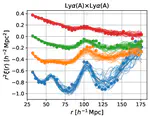
We present baryon acoustic oscillation (BAO) measurements using the Lyman-$\alpha$ (Ly$\alpha$) forest from the second data release (DR2) of the Dark Energy Spectroscopic Instrument (DESI) survey. Our BAO measurements include both the auto-correlation of Ly$\alpha$ forest absorption observed in the spectra of high-redshift quasars and the cross-correlation of the absorption with quasar positions. The total sample size is approximately a factor of two larger than that of DR1, with forest measurements in over 820{,}000 quasar spectra and the positions of more than 1.2 million quasars. We describe several significant improvements to the analysis in this paper, while two companion papers detail improvements to the synthetic data sets used for validation and the identification of damped Ly$\alpha$ absorbers. Our main result is a measurement of the BAO scale with a statistical precision of $1.1%$ along and $1.3%$ transverse to the line of sight, corresponding to a combined precision of $0.65%$ on the isotropic BAO scale at $z_{\mathrm{eff}} = 2.33$. This excellent precision, together with recent theoretical studies of the BAO shift induced by nonlinear growth, motivates the inclusion of a systematic error term in Ly$\alpha$ BAO analyses for the first time. We measure the ratios $D_H(z_{\mathrm{eff}})/r_d = 8.632 \pm 0.098 \pm 0.026$ and $D_M(z_{\mathrm{eff}})/r_d = 38.99 \pm 0.52 \pm 0.12$, where $D_H = c/H(z)$ is the Hubble distance, $D_M$ is the transverse comoving distance, $r_d$ is the sound horizon at the drag epoch, and we quote both statistical and theoretical systematic uncertainties. A companion paper presents the BAO measurements at lower redshifts from the same data set and their cosmological interpretation.
DESI DR2 Results I: Baryon Acoustic Oscillations from the Lyman Alpha Forest