ForestFlow: cosmological emulation of Lyman-α forest clustering from linear to nonlinear scales
Abstract
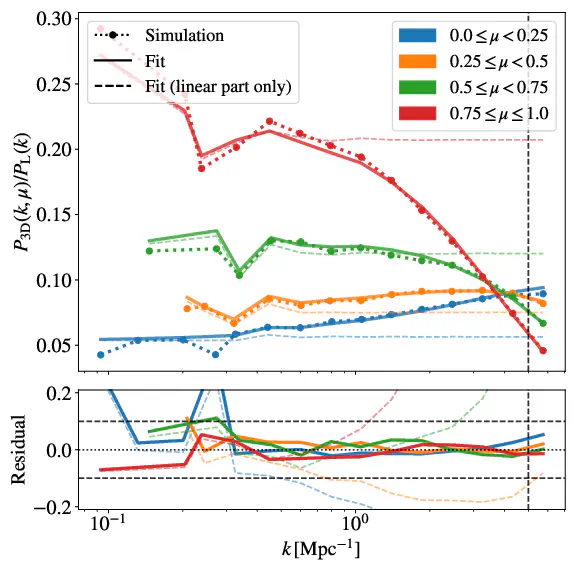
On large scales, measurements of the Lyman-$\alpha$ forest provide insights into the expansion history of the Universe, while on small scales they impose stringent constraints on the growth history, the nature of dark matter, and the sum of neutrino masses. In this work, we introduce \texttt{ForestFlow}, a cosmological emulator designed to bridge the gap between large- and small-scale Lyman-$\alpha$ forest analyses. Using conditional normalizing flows, \texttt{ForestFlow} emulates the two Lyman-$\alpha$ linear bias parameters ($b_\delta$ and $b_\eta$) and six parameters describing small-scale deviations of the three-dimensional flux power spectrum ($P_\mathrm{3D}$) from linear theory. These eight parameters are modeled as functions of cosmology—specifically the small-scale amplitude and slope of the linear matter power spectrum—and the physics of the intergalactic medium. In combination with a Boltzmann solver, \texttt{ForestFlow} can therefore predict $P_\mathrm{3D}$ on arbitrarily large (linear) scales and the one-dimensional flux power spectrum ($P_\mathrm{1D}$), the primary observable for small-scale analyses, without the need for interpolation or extrapolation. As a result, \texttt{ForestFlow} enables multiscale analyses for the first time. Trained on a suite of 30 fixed-and-paired cosmological hydrodynamical simulations spanning redshifts $z = 2$ to $4.5$, \texttt{ForestFlow} achieves precisions of $3%$ and $1.5%$ in modeling $P_\mathrm{3D}$ and $P_\mathrm{1D}$, respectively, from linear scales up to $k = 5,\mathrm{Mpc^{-1}}$ and $k_\parallel = 4,\mathrm{Mpc^{-1}}$. Owing to its parameterization, the emulator maintains similar precision for different ionization histories and for two extensions of the $\Lambda$CDM model—massive neutrinos and spatial curvature—that were not included in the training set. \texttt{ForestFlow} will be crucial for the cosmological analysis of Lyman-$\alpha$ forest measurements from the DESI survey.