DESI DR1 Ly forest: 3D full-shape analysis and cosmological constraints
Abstract
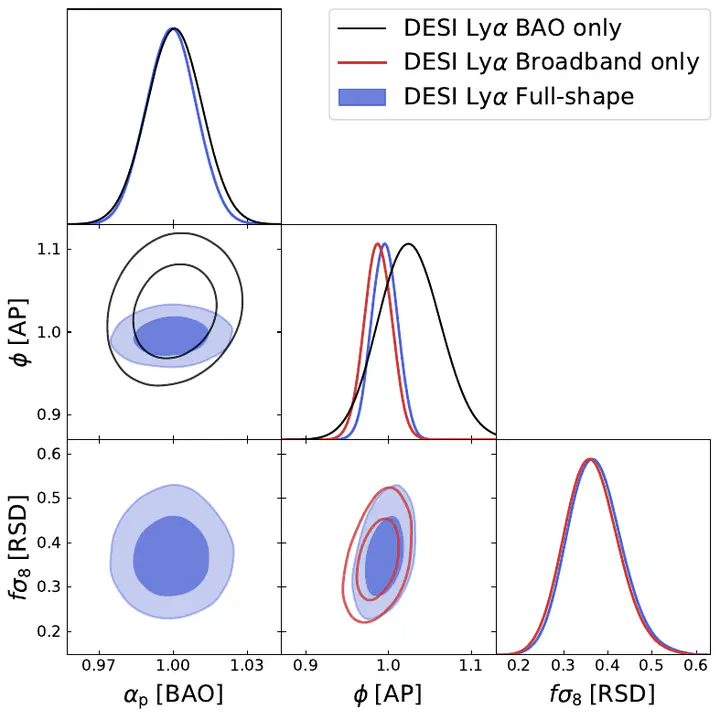
We perform an analysis of the full shapes of the Lyman-$\alpha$ (Ly$\alpha$) forest correlation functions measured from the first data release (DR1) of the Dark Energy Spectroscopic Instrument (DESI). Our analysis focuses on measuring the Alcock–Paczynski (AP) effect and the cosmic growth rate times the amplitude of matter fluctuations in spheres of $8,h^{-1},\mathrm{Mpc}$, $f\sigma_8$. We validate our measurements using two different sets of mocks, a series of data splits, and a large set of analysis variations, which were first performed blinded. Our analysis constrains the ratio $D_M/D_H(z_\mathrm{eff}) = 4.525 \pm 0.071$, where $D_H = c/H(z)$ is the Hubble distance, $D_M$ is the transverse comoving distance, and the effective redshift is $z_\mathrm{eff} = 2.33$. This is a factor of $2.4$ tighter than the baryon acoustic oscillation (BAO) constraint from the same data. When combining with Ly$\alpha$ BAO constraints from DESI DR2, we obtain the ratios $D_M/r_d$ and $D_H/r_d$, where $r_d$ is the sound horizon at the drag epoch. We also measure $f\sigma_8$, but we do not use it for cosmological inference due to difficulties in its validation with mocks. In $\Lambda$CDM, our measurements are consistent with both cosmic microwave background (CMB) and galaxy clustering constraints. Using a nucleosynthesis prior but no CMB anisotropy information, we measure the Hubble constant to be $H_0 = 67.5 \pm 1.3,\mathrm{km,s^{-1},Mpc^{-1}}$ within $\Lambda$CDM. Finally, we show that Ly$\alpha$ forest AP measurements can help improve constraints on the dark energy equation of state and are expected to play an important role in upcoming DESI analyses.