Calibrating redshift distributions at z>2 with Lyman-α forest cross-correlations
Abstract
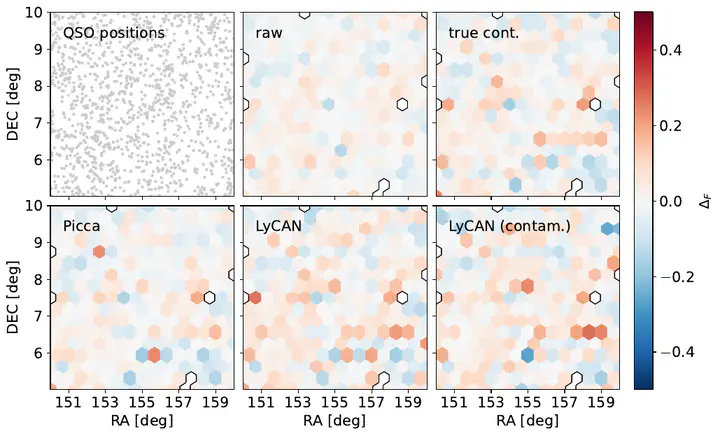
We explore the feasibility of using Lyman-α (Lyα) forests to calibrate the ensemble redshift distribution of the high-redshift tail (2 < z < 3) of photometric galaxies. We use CoLoRe simulations to create mock DESI 5-year Lyα forests and Rubin Observatory LSST 10-year photometric galaxy samples up to z = 3, and measure the galaxy redshift distribution via their angular cross-correlations. Due to large redshift-space distortions in the Lyα forest, the conventional n(z) estimator for clustering redshifts does not apply, and we develop a theoretical framework to model the angular cross-correlation directly. Using the simulations, we explore the effects of instrumental noise, continuum fitting, and contamination in the Lyα forest, as well as the impact of angular cross-correlation scales (θ) and redshift bin size (Δz) on the signal-to-noise ratio (SNR) of the measurements. We find that continuum-fitting methods strongly impact the SNR. With our baseline continuum-fitting method, LyCAN, at angular scales θ ≃ 10 arcmin and Δz = 0.1, we measure the cross-correlation signal at 24σ significance. If the shape of the redshift distribution and the galaxy-bias evolution are well known for z < 2, the cross-correlation can constrain the mean redshift of the galaxy sample to σₓ / (1 + z̄) = 0.006 at a mean redshift of z̄ = 2. This demonstrates that Lyα cross-correlation is a reliable and promising method to calibrate the high-redshift tails of photometric Stage-IV galaxy surveys.