Cosmological analysis of the DESI DR1 Lyman alpha 1D power spectrum
Abstract
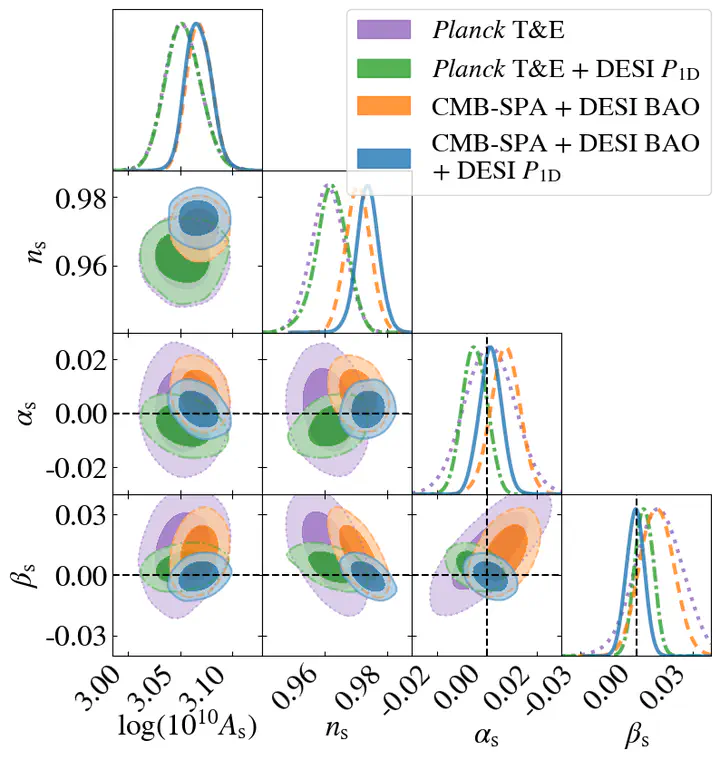
We present the cosmological analysis of the one-dimensional Lyman-α (Lyα) flux power spectrum from the first data release of the Dark Energy Spectroscopic Instrument (DESI). We capture the dependence of the signal on cosmology and intergalactic-medium physics using an emulator trained on a cosmological suite of hydrodynamical simulations, and we correct its predictions for the impact of astrophysical contaminants and systematics, many of which were not considered in previous analyses. We employ this framework to constrain the amplitude and logarithmic slope of the linear matter power spectrum at k* = 0.009 km⁻¹ s and redshift z = 3, obtaining Δ² = 0.379 ± 0.032 and n = −2.309 ± 0.019. The robustness of these constraints is validated through the analysis of mock data and a large number of alternative data-analysis variations, with cosmological parameters kept blinded throughout the validation process. We then combine our results with constraints from DESI baryon acoustic oscillations and temperature, polarization, and lensing measurements from Planck, ACT, and SPT-3G to constrain extensions of ΛCDM. While our measurements do not significantly tighten the limits on the sum of neutrino masses from the combination of these probes, they sharpen the constraints on the effective number of relativistic species, N_eff = 3.02 ± 0.10, the running of the spectral index, α_s = 0.0014 ± 0.0041, and the running of the running, β_s = −0.0006 ± 0.0048, by factors of 1.18, 1.27, and 1.90, respectively. We conclude by outlining the improvements needed to fully reach the level of confidence implied by these uncertainties.