DESI DR2 Results IV: Alcock-Paczyński Measurements from the Lyman Alpha Forest and Cosmological Constraints
Abstract
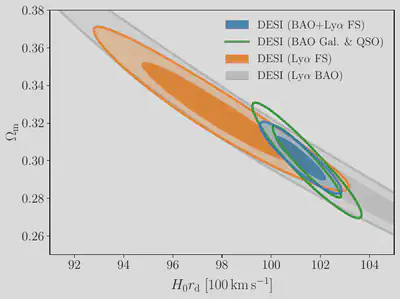
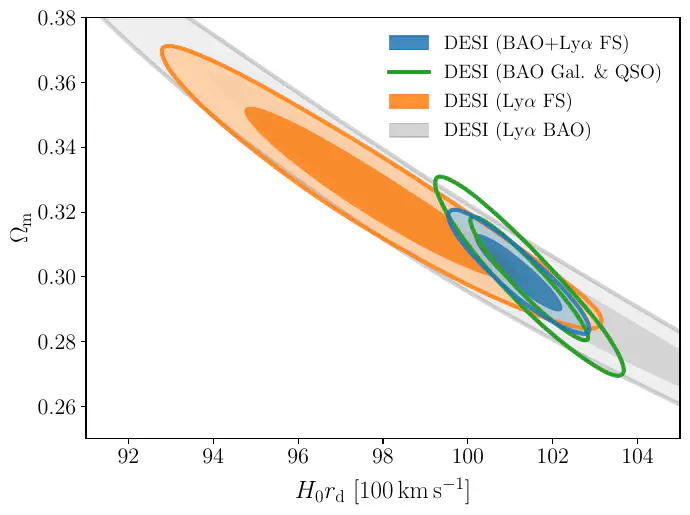
We present Alcock-Paczyński (AP) measurements from the full shape of Lyman-$\alpha$ (Ly$\alpha$) forest correlation functions measured from the second data release (DR2) of the Dark Energy Spectroscopic Instrument (DESI). Our measurements include information from the Ly$\alpha$ forest auto-correlation and its cross-correlation with quasars. We constrain the AP effect with $1%$ precision at an effective redshift $z_\mathrm{eff}=2.33$, which is twice as tight as the Baryon Acoustic Oscillation (BAO) constraint from the same data. When using the joint Ly$\alpha$ AP and BAO results, we measure the ratios $D_\text{H}(z_\mathrm{eff})/r_\text{d}=8.600 \pm 0.066$ and $D_\text{M}(z_\mathrm{eff})/r_\text{d}=39.32 \pm 0.33$, where $D_\text{M}$ is the transverse comoving distance, $D_\text{H}$ is the Hubble distance, and $r_\text{d}$ is the sound horizon at the drag epoch. Assuming $\Lambda$CDM, Ly$\alpha$ forest measurements combined with a nucleosynthesis prior produce a constraint on the Hubble constant $H_0=66.5\pm1.3,\mathrm{km,s^{-1},Mpc^{-1}}$. The Ly$\alpha$ AP result corresponds to a matter fraction constraint $\Omega_\text{m}=0.325\pm0.018$ in $\Lambda$CDM, which is $1.4\sigma$ higher than DESI BAO. This impacts the DESI results relative to the Cosmic Microwave Background (CMB), slightly reducing their discrepancy from $2.4\sigma$ to $2.2\sigma$. We present updated constraints on extended models using the joint DESI DR2 BAO and Ly$\alpha$ forest full shape data, together with external data sets. When considering a time-evolving dark energy equation of state parametrized by $w_0$ and $w_a$, we find it is preferred over $\Lambda$CDM at $2.7\sigma$ for the combination of DESI and CMB data, and at $3.2\sigma$ when also including supernovae. With the new Ly$\alpha$ AP measurement, DESI provides its most precise anchor for the expansion history at $z > 1$ in the matter-dominated Universe.